What the American Gut Project Actually Found About Plant Diversity
Key finding
People who reported eating more than 30 different plant species per week had significantly more diverse gut microbiomes than people eating 10 or fewer — regardless of whether they identified as vegan, vegetarian, or omnivore.

Not medical advice — general information based on published research.Full disclaimer →
The American Gut Project is a large, crowd-sourced microbiome study — participants sent in stool samples and detailed dietary questionnaires, and researchers sequenced the microbial DNA to characterise each person's gut bacterial community. With that scale of data, the researchers could compare microbial diversity against many possible dietary variables, from calorie intake to specific diet labels to the sheer number of distinct plant foods eaten.
Most “eat more plants for gut health” advice doesn’t cite a specific study. This one is the actual source behind the most commonly repeated version of that advice — and it’s worth reading what it did and didn’t establish.
What the researchers actually did
The American Gut Project [1] is a large citizen-science microbiome study: over 10,000 volunteers across several countries submitted stool samples for microbial DNA sequencing along with detailed dietary and lifestyle questionnaires. That scale let researchers compare microbial diversity against a wide range of variables — total calories, macronutrient ratios, specific diet labels, and simple counts of how many distinct plant species a person reported eating in a typical week.
What it found
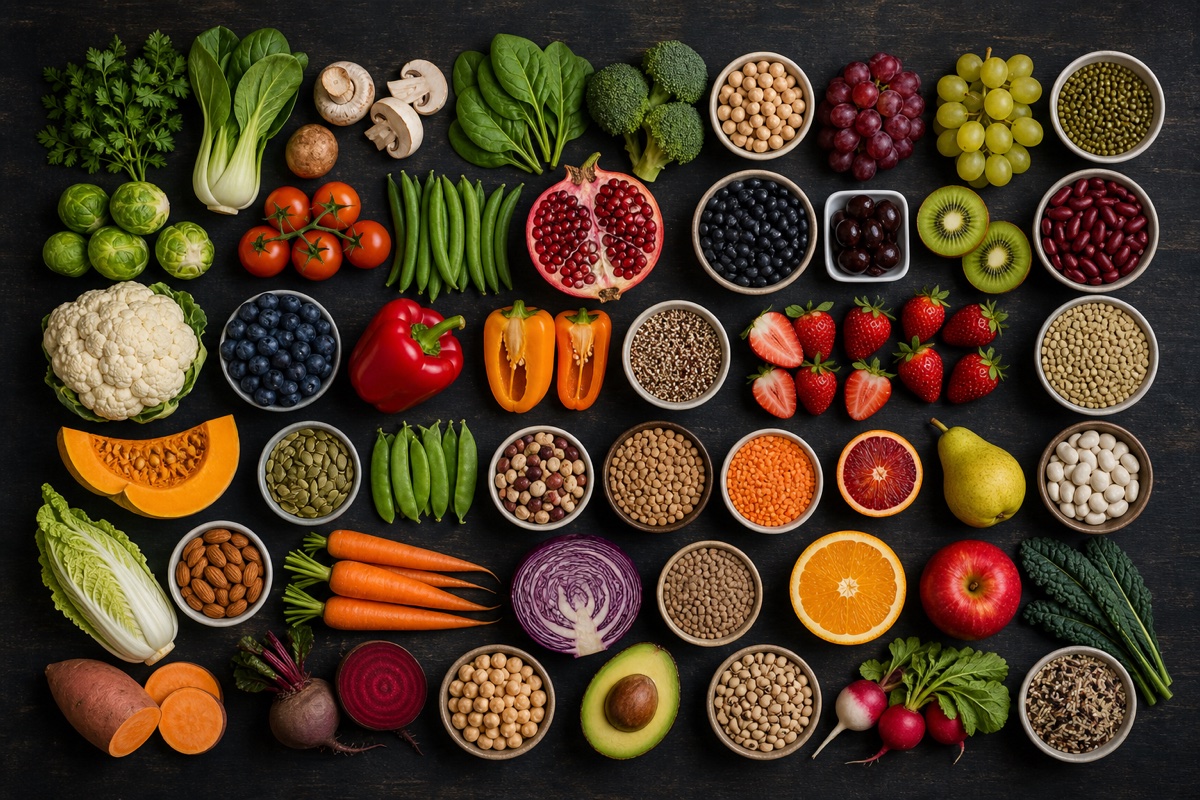
Plant variety — not diet label, not total fibre intake alone — was the standout predictor. People eating more than 30 different plant species a week had meaningfully more diverse gut microbiomes than people eating 10 or fewer, and this held regardless of whether participants identified as vegan, vegetarian, or omnivore. A related mechanistic review [2] explains why variety specifically matters: different fibre structures feed different bacterial species, so a narrow diet — even a high-fibre one — feeds a narrower set of microbes well, while a varied diet feeds a broader community.
Why it matters
This is the actual evidence behind the “30 plants a week” target that shows up across nutrition content, including this site’s own gut-health deep-dive. It’s worth readers knowing the number comes from an observed pattern in a large dataset, not a precise clinical threshold — a genuinely useful target, held with the right amount of confidence.
Why it matters
This is the origin of the popular '30 plants a week' target used across wellness and nutrition content, including on this site. It matters because the finding is specifically about variety of plant intake, not any single diet label or superfood — someone eating a narrow vegan diet and someone eating a narrow omnivorous diet can both have lower microbial diversity than someone eating a broad range of plant foods regardless of animal-product inclusion.
What this study doesn’t tell us
- This is an observational, cross-sectional study — it shows a strong association between plant variety and microbial diversity, not a proven causal chain, and it can't rule out that people who eat more varied plant diets differ in other health-relevant ways too.
- Diet data came from self-reported questionnaires, which carry the usual recall and reporting biases of any self-reported dietary data.
- '30 plants a week' is a threshold observed in this dataset, not a precisely validated clinical target — it's a reasonable, evidence-informed goal rather than a number with an established mechanistic cutoff at exactly 30.
- The study doesn't directly measure downstream health outcomes (disease risk, mood, etc.) — it measures microbial diversity itself, which is associated with but not identical to health outcomes.
Sources cited
- [1]McDonald D, Hyde E, Debelius JW, et al. (2018). American Gut: an Open Platform for Citizen Science Microbiome Research . mSystems.Observational
- [2]Deehan EC, Walter J (2016). The Fiber Gap and the Disappearing Gut Microbiome: Implications for Human Nutrition . Trends in Endocrinology & Metabolism.Guideline