Collagen Supplements

This page discusses a supplement, nootropic, or ingestible health claim.Nothing here is a recommendation to take or avoid a specific product, and none of it is a therapeutic claim. In Australia, supplement claims are regulated by the Therapeutic Goods Administration (TGA) — this page isn't one of those regulated claims, it's a plain-language read of the public research.
Alex Busse is a nutritionist. This is general, research-based information, not individualised medical advice. Read the full disclaimer →
What it actually is
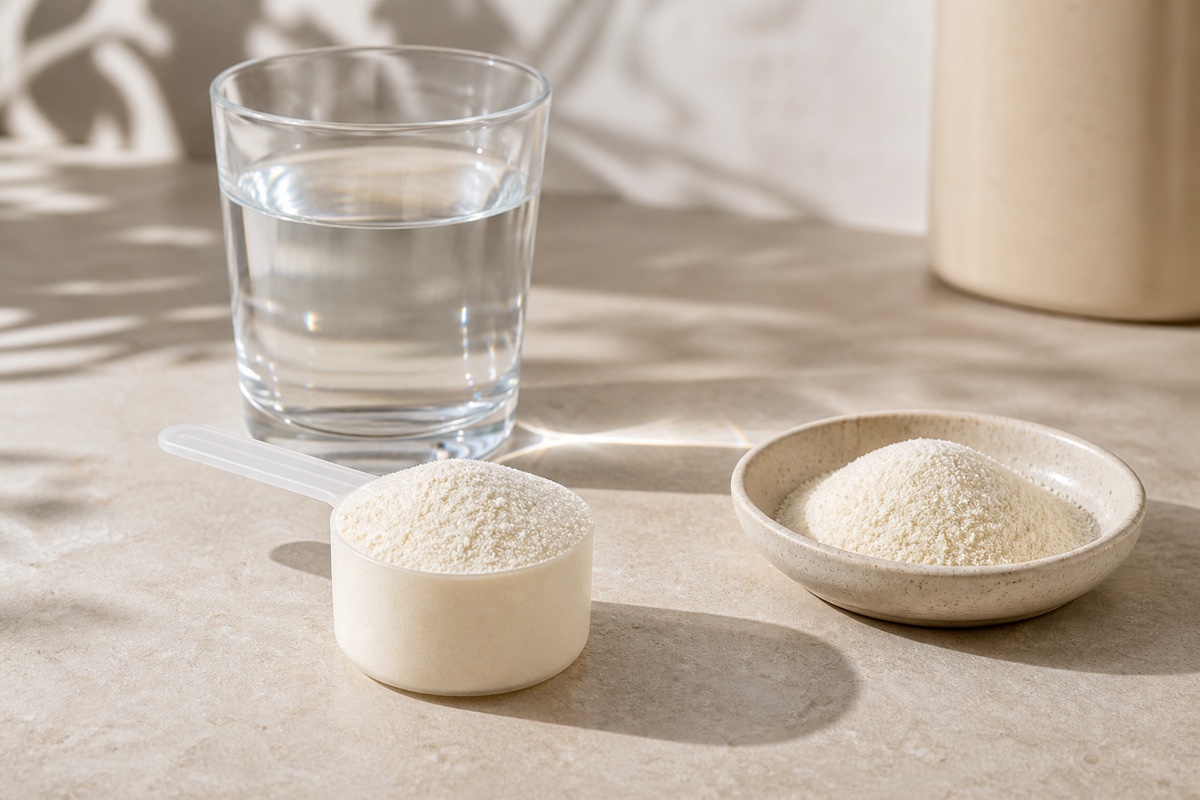
Hydrolysed collagen powder or capsules, marketed for skin elasticity, joint comfort, and 'anti-aging' benefits, usually sourced from bovine or marine collagen and broken down into peptides for absorption.
What the evidence shows
Several small-to-moderate randomized trials and a couple of systematic reviews find modest improvements in skin elasticity and hydration with consistent use over 8-12 weeks, with less consistent evidence for joint-pain outcomes. Most trials are industry-funded, which doesn't invalidate the findings but is worth knowing.
Collagen supplements sit in an unusually well-studied corner of the supplement aisle compared to most “beauty from within” products — which makes it a good test case for what “the evidence is real but modest, and mostly industry-funded” actually looks like.
What it actually is
Collagen is the most abundant structural protein in skin, tendons, and joints. Supplements are typically hydrolysed — broken down into smaller peptides — on the theory that this improves absorption and that specific peptide fragments can act as signalling molecules that stimulate the body’s own collagen production, rather than being incorporated wholesale into skin tissue.
What the evidence shows
A 2021 systematic review and meta-analysis in the International Journal of Dermatology [1] pooled multiple randomized trials of hydrolysed collagen supplementation and found consistent improvements in skin elasticity and hydration, generally emerging after 8-12 weeks of daily use.
The conflict-of-interest point is worth stating plainly, in keeping with this site’s sourcing policy: a meaningful share of the trials in this literature — including several in the review above — were funded by collagen supplement manufacturers. That doesn’t automatically invalidate the results, and the effect has been observed across multiple independent research groups, not just one company’s in-house studies. But it’s exactly the kind of context a skeptical read should surface rather than skip past.
A related paper [2] covers the more basic question of how collagen peptides fit into overall dietary protein and amino acid balance — useful background, though it’s more a nutritional-composition analysis than a clinical outcomes trial.
Where the evidence is thinner
Joint-pain and joint-health claims for collagen are more mixed and less consistently supported across trials than the skin-elasticity findings — some individual trials show benefit, particularly in athletes with joint pain, but the pooled picture is less settled than the skin literature.
”Modest effect, mostly industry-funded trials, more consistent for skin than joints” isn’t as exciting as the marketing, but it’s the accurate summary.
Worth trying?
Reasonably, for skin-elasticity goals specifically, with realistic expectations: a modest improvement after consistent use over months, not a dramatic transformation. The joint-health case is weaker and more individual. Either way, this is supplement-adjacent content — nothing here is a recommendation to take a specific product or brand.
Common questions
Does collagen supplementation actually work for skin?
A 2021 systematic review and meta-analysis found consistent improvements in skin elasticity and hydration across the pooled trials, typically after 8-12 weeks of daily use — a real if modest effect, though most trials were industry-funded.
Is oral collagen actually absorbed intact?
No — collagen is broken down into smaller peptides and amino acids during digestion, the same as other dietary protein. The proposed mechanism is that specific collagen-derived peptides may signal skin cells to produce more of their own collagen, not that the supplement is absorbed and 'installed' directly.
Sources cited
- [1]de Miranda RB, Weimer P, Rossi RC (2021). Effects of hydrolyzed collagen supplementation on skin aging: a systematic review and meta-analysis . International Journal of Dermatology.Several included trials were funded by collagen supplement manufacturers.Meta-analysis
- [2]Paul C, Leser S, Oesser S (2019). Significant Amounts of Functional Collagen Peptides Can Be Incorporated in the Diet While Maintaining Indispensable Amino Acid Balance . Nutrients.Guideline
Related on thesmartplate.org
What a Creatine and Cognition Review Actually Found
A systematic review of RCTs found creatine supplementation gave modest cognitive benefits, most consistently under cognitive stress like sleep deprivation, or in people with lower baseline creatine stores, such as vegetarians.

Do Nootropics Actually Work?
Some compounds marketed as nootropics have real trial support. Most of the 'stack' culture around them doesn't. Here's the difference.

Mushroom Coffee
Instant coffee blended with extracts of functional mushrooms — most commonly lion's mane and chaga — marketed as a lower-caffeine, calmer alternative to regular coffee that supposedly adds cognitive and immune benefits on top.